What Is the GRAI? A Simplified Guide to Ireland’s New Gambling Regulator
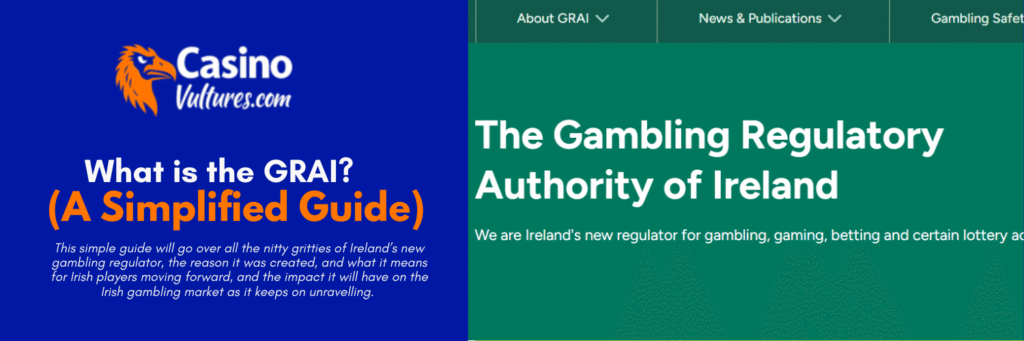
Anyone in Ireland’s gambling space has probably come across the acronym GRAI. But what is it really? What does it do? And why is it necessarily important for anyone who engages with online casinos in Ireland? You may ask…
This simple guide will go over all the nitty gritties of Ireland’s new gambling regulator, the reason it was created, and what it means for Irish players moving forward, and the impact it will have on the Irish gambling market as it keeps on unravelling.
What Is the GRAI?
GRAI is Ireland’s official Independent Regulator for Gambling that was established under the Gambling Regulation Act 2024. Its existence signifies one of the most influential Irish Gambling law in years; coming in to replace an entirely outdated regulatory framework. It runs under the department of justice, however its functions are rolled out independently.
Its primary role is to ensure that gambling in Ireland remains as fair and transparent as possible. Consequently, it oversees the process of licensing, regulating and following up on all gambling operators serving Irish players. A crucial role of its mandate is to safeguard vulnerable groups, especially children and any individuals facing risk of addiction.
Before the existence of GRAI, there was no single body with this level of authority. Irish gambling regulation was literally a hodgepodge of outdated laws and splintered responsibility spread over multiple government departments. The GRAI changed all of that essentially; and for Irish players, the GRAI’s impact is significant.
Why Was the GRAI Created?
To understand the importance of GRAI, you need to understand the state of Irish gambling regulation, before it existed. The short of it; “it was a hot mess”.
The primary legislation managing gambling in Ireland before the Gambling Regulation Act 2024 was the Betting Act 1931 and the Gaming and Lotteries Act 1956. And yes those dates are nothing short of alarming. The Betting Act was published 94 years ago. The Gaming and Lotteries Act precedes the internet by four decades. Neither piece of legislation had any worthwhile concept of online gambling, digital payments, or the existing kind of player protection tools that are now deemed as basic standards in well-regulated markets.
What this meant in reality was that online gambling in Ireland was operating in a grey area for decades. Global operators could serve Irish players, and millions of Irish players made use of these platforms, with no existing domestic regulatory oversight, no Irish authority to escalate complaints to, and no regular standards to cater for player protection. The regulation in operation previously solely focused on tax collection via the Revenue Commissioners as opposed to player welfare, game fairness, or operator accountability.
That is the scope of the changes that have taken place. Ireland has essentially moved from a gambling market with no active domestic online gambling regulation to one with a dedicated, effective regulator in a single legislative step.
What Does the GRAI Actually Do?
The GRAI has a couple of core functions that together cover the full scope of gambling regulation in Ireland.
Licensing Operators
The GRAI hands out licenses to gambling operators who intend to serve Irish customers legally. Without a GRAI license, an operator isn’t able to legally provide gambling services to people in Ireland; and the authority has enforcement abilities to shut down those that try.
The GRAI governs gambling, betting, gaming and lottery activities that include certain lotteries such as bingo, gaming machine providers, gambling software providers, and remote gambling; gambling either online or by phone.
Licenses are typically handed out in phases. However, the principle is clear: if a gambling operator is gunning for Irish players’ money, it must abide by GRAI standards and hold GRAI’s authorization.
Enforcing Player Protection Standards
Licensing is not “just” a rubber stamp. Operators are still prone to ongoing compliance monitoring, and the GRAI still have the authority to investigate operators, enforce compliance, apply relevant sanctions, and take action against unlicensed or any illegal activity.
The financial penalties for an operator breaching GRAI regulations are huge. Fines go up to €20 million or 10% of turnover, whichever is higher, for licensee breaches. This happens to be one of the largest statutory fine ceilings for gambling breaches in the EU and it awards GRAI massive commercial leverage over operators; non-compliance is not a small inconvenience, it is a huge threat to an operator’s business.
Managing the National Gambling Exclusion Register
One of the most functional crucial things the GRAI does for Irish players is run the National Gambling Exclusion Register. The regulator will build a National Gambling Exclusion Register, that’s identical to the UK’s GamStop, which all licensees must ultimately join.
This is a big step forward. Previously, if an Irish player intended to self-exclude from gambling, they had to handle it casino by casino; a strenuous process that left potential gaps wherever they had not yet registered. The GRAI’s national register permits a single registration that applies across all GRAI-licensed operators at the same time.
Banning Credit Card Gambling
Among the measures put in place, is a ban on using credit cards as a method of payment for gambling. This is a big consumer protection measure that a couple of other jurisdictions; most notably the UK, have already put in place. Gambling on credit builds a specifically dangerous situation where losses are “literally” borrowed money, escalating the financial harm that can come from problems with gambling. The GRAI’s credit card ban closes this off completely for licensed operators.
If a player tries to deposit at a GRAI-licensed casino using an Irish credit card, it won’t work; and this is by design.
Restricting Inducements and Bonuses
This one will grab the attention of any Irish player who has been lured by a casino’s welcome bonus offer. It will be an illegal act for a licensed gambling body to give you any form of incentive to encourage you to gamble or to keep on gambling; for example, free bets to lure you to gamble, to continue gambling, or to deter you from stopping gambling.
The advertising regime stops incitementss, free-bet offers conditioned on deposits, and sponsorship of children’s events. This hence means the traditional welcome bonus structure; deposit €100, get €100 free will become illegal for GRAI-licensed operators running under this framework. The industry is still navigating how exactly these rules will take place in practice, and there is some regulatory guidance that is still in development, but the direction of travel is clear: the olden days of aggressive bonus marketing to Irish players are numbered for licensed operators.
Regulating Gambling Advertising
New rules will also be established on advertising. These include adults being required to opt in order to receive marketing communications and a ban on gambling advertising across TV and radio between the 5:30am and 9pm duration.
This watershed means that gambling adverts won’t appear on Irish TV and radio during the hours when children are likely to be watching or listening. Apart from the watershed, the rules around digital advertising, social media, and influencer marketing are also being stiffened substantially.
Operating the Social Impact Fund
A new industry levy will secure at least €14 million yearly for a Social Impact Fund to uphold addiction treatment, public education, research, and community interventions. This fund is essentially paid for by gambling operators, and not taxpayers. And it portrays a meaningful financial commitment to tackle gambling-related harm at a societal level.
The GRAI Licensing Timeline: Where things stand currently
The GRAI is gradually rolling out its licensing framework in closely monitored phases. Here is a distinct breakdown of where things stand as of now.
Phase 1: Remote Betting Licenses (Live from 1 July 2026)
Wednesday, 1st July 2026: Remote betting and betting intermediary licenses issued by the Gambling Regulatory Authority of Ireland start in 1st July, 2026, in the latest key step in Ireland’s new regulatory regime for the gambling sector. The initial licenses only catered for betting services online.
This therefore, means online sportsbooks and sports betting operators serving Irish players are now running under GRAI betting licenses; or they are fully operating illegally. The shift from the old Revenue Commissioners licensing system to GRAI licensing is finalized for this category as of 1 July 2026.
Phase 2: Remote Gaming Licenses (Online Casinos)
Remote gaming licenses; this is the category that includes online casinos as opposed to sports betting platforms. These are slated to open later in 2026, with the full transition predicted to complete into 2027. This hence means that as of July 2026, online casinos serving Irish players are still running under foreign licenses; exclusively under the Malta Gaming Authority, Gibraltar Regulatory Authority, or UK Gambling Commission; during this transition period.
This is entirely legal and expected. Irish players can keep on using MGA and Gibraltar-licensed casinos during this period and those licenses offer legitimate player protection via their own regulatory frameworks. Once GRAI casino licenses is issued, the expectation is that reputable operators catering for Irish players will transition to GRAI licensing as their exclusive Irish authorization.
Phase 3: In-Person Betting Licenses (December 2026)
B2C in-person betting operators can be licensed from 1 December 2026. This covers physical betting shops and land-based operations.
Phase 4: B2B Licenses (2027 and Beyond)
B2B licenses; that cover software providers, platform suppliers, and other businesses serving operators as opposed to directly serving players; are scheduled for 2027.
Magnús Már Quick Tip:

Bookmark grai.ie and check it out when assessing any online casino or sportsbook targeting Irish players. When the GRAI’s public register is completely populated, you’ll be able to search for any operator by name and verify whether they hold a valid GRAI license. This only takes two minutes and is the most trustworthy way to verify regulatory status; far more reliable than just relying on the license badge on a casino’s own website, which could be outdated or misrepresented.
What the GRAI Means for Irish Casino Players
Understanding GRAI’s structure is one thing. However, comprehending what it actually means for your experience as an Irish casino player is more important. Here is the realistic breakdown.
You Will Have an Irish Regulator to Complain To
This is sincerely significant. Before the GRAI, in case an online casino treated you unfairly; withheld a withdrawal, nullified winnings unreasonably, declined to honor a self-exclusion request; your options were solely to express these frustrations to a foreign regulator (the MGA or Gibraltar authority) who had no specific obligation to prioritize an Irish player’s complaint, or to take any legal action in a foreign jurisdiction.
With the GRAI established, Irish players have an active domestic regulator with direct enforcement powers over licensed operators. The GRAI can analyze complaints, oblige operators to respond, and inflict sanctions on operators who breach their obligations toward Irish players.
Responsible Gambling Tools Will Be Mandatory and Standardized
Under the GRAI framework, all licensed operators should offer a particular set of player protection tools; deposit limits, session time limits, reality checks, and access to the national self-exclusion register. These are not optional attributes that a casino can choose whether to put in place or bury in account settings. They are fully legal obligations with enforcement outcomes for operators who fail to offer them correctly.
This means Irish players will have an assured minimum criterion of responsible gambling provision at any GRAI-licensed operator; a huge improvement over the current situation where the quality and accessibility of these tools depends immensely between platforms.
No More Credit Card Deposits
If you’ve been funding your casino account with a credit card, that alternative is no longer an option at GRAI-licensed operators. Debit cards, e-wallets including PayPal, Skrill and Neteller, bank transfers, Revolut, and Paysafecard are still available. This change eradicates one of the most financially hazardous ways to gamble, on loaned money; and this is a sincere player protection initiative rather than a bureaucratic inconvenience.
Welcome Bonuses Will Change Significantly
The GRAI’s inducement rules mean that the customary casino welcome bonus; claim a percentage match on your deposit, meet the wagering requirement, withdraw your winnings; is not consistent with GRAI licensing as currently structured. Exactly how the industry adjusts to this is still being worked out, but Irish players using GRAI-licensed operators should expect bonus structures to look deliberately different from what they are accustomed to on foreign-licensed platforms.
Gambling Ads Will Be Less Intrusive
The advertising watershed and opt-in requirement for direct marketing inherently means less gambling advertising in your daily life for you as an Irish resident. Television and radio gambling ads won’t be available before 9pm. You only receive marketing from gambling operators if you have particularly opted in to receive them. Social media advertising is more limited. This is a quality of life change that portrays a broader public health approach to gambling regulation.
Is It Still Legal to Use Foreign-Licensed Casinos in Ireland?
Yes. And this is a common question about the GRAI transition. Irish residents can still legally engage at online casinos holding valid foreign licences; like MGA, Gibraltar, UKGC, on this the transition period. There is essentially no law that criminalizes Irish individuals from accessing properly licensed offshore gambling platforms.
The legal obligations under the GRAI framework fall exclusively on operators rather than individual casino players. If an operator fails to obtain GRAI licensing then they do face enforcement action from the GRAI. On the other hand, an individual Irish player using a foreign-licensed platform doesn’t.
Once GRAI casino licensing is completely operational, the assumption is that reputable operators serving the Irish market will hold GRAI licenses. Those that won’t will be running in breach of their obligations under Irish law; and the GRAI has the power to seek court orders blocking access to prohibited services and blocking payments to payment providers.
At Casino Vultures, we track GRAI licensing status as part and parcel of our review process and will update our Irish recommendations as the licensing factor develops.
Magnús Már Quick Tip:
During this transition period, the realistic standard for Irish players is to engage with casinos holding MGA or Gibraltar licences as the minimum. These are the foreign licenses that offer significant regulatory protection as compared to what the GRAI will provide domestically. Casinos running under Curaçao licences solely are a lower-protection option during this period. Once GRAI casino licenses are issued, a GRAI license will become the major thing to look for in any casino serving Irish players.
How to Check if a Casino Is GRAI Licensed
Once the GRAI’s public register is 100% operational, the process is simple.
Visit grai.ie and go to the public register of licensed operators. Go on to search for the operator by name. In case they appear in the register with a valid, active license in the relevant category; remote betting or remote gaming that is; depending on what you are essentially looking for, then they are legally GRAI licensed. If they allege to be GRAI licensed but do not appear in the register that could be a serious red flag.
In the current transition period, while casino gaming licenses haven’t been handed yet, checking the MGA register at mga.org.mt or the Gibraltar register could serves the same verification function for the foreign licenses being utilized.
Do not rely on the license badge showcased in a casino’s own footer. These can often be outdated, fabricated, or misrepresented. The regulator’s own website is the only authoritative source.
The GRAI’s Enforcement Powers
One of the most crucial discrepancies between the GRAI and some of the foreign regulators Irish players have previously counted on is the scale of enforcement authority the GRAI comes with.
The GRAI will attain authority to impose penalties up to €20 million or 10% of revenue. The authority also has the ability to suspend or revoke licenses, pass on criminal matters to the DPP, and apply to the High Court for orders obstructing access to illegal gambling services and blocking payments to non-compliant operators.
There are over 30 criminal offences under the Act, a figure which attracts huge custodial sentences of up to eight years’ imprisonment.
This is not a regulatory framework that’s superficial. The GRAI comes with real legal authority, real financial penalties, and real criminal enforcement powers. And for Irish players, this means its licensed operators have commercial and legal incentives to abide by player protection requirements; a significantly different situation from a gambling market where regulatory oversight was theoretical at best.
The National Self-Exclusion Register: (Ireland’s Version of GamStop)
For any Irish players who’ve had their share of gambling struggles and looking for a comprehensive way to exclude themselves from the market, the GRAI’s National Gambling Exclusion Register is the most practical new tool that’s available.
Shaped on the UK’s GamStop system, the register permits an Irish player to register once and they can be excluded from all GRAI-licensed operators at the same time. This essentially closes the gap that has always existed with self-exclusion on each casino; where a casino player may exclude from one platform but still be accessible on all the others they have registered accounts on.
Once the register is 100% operational, registering on it is the best practical self-exclusion tool accessible to Irish players. All GRAI-licensed operators are legally required to join the register and acknowledge exclusions registered on it.
Magnús Már Quick Tip:
If you are planning to utilize the national self-exclusion register when it becomes fully operational, you shouldn’t just wait for it to be your only option. Proceed to self-exclude from individual casinos via their responsible gambling settings instantly; this offers protection at those specific operators immediately. Then go on to register on the GRAI’s national register when it’s live and functioning to extend that protection over the entire licensed market in one step.
Frequently Asked Questions
- What is the GRAI in simple terms? The Gambling Regulatory Authority of Ireland is Ireland’s new independent gambling regulator, created under the Gambling Regulation Act 2024. It’s responsible for licensing gambling operators, enforcing player protection rules, running the national self-exclusion register, and regulating gambling advertising in Ireland. It is the first time in history, Ireland has had a single, dedicated platform with this scope of regulatory authority over the entire gambling market.
- When was the GRAI established? The Gambling Regulation Act 2024 was established on 23 October 2024. The GRAI formally started its operations on 5th March, 2025. The Minister for Justice signed the commencement order authorizing licensing on 3 February 2026, with remote betting licenses starting on 1 July 2026.
- Is it legal to gamble at online casinos in Ireland in 2026? Yes. Online gambling is 100% legal for Irish residents. In this GRAI’s transition period, Irish players can still legitimately have access to online casinos that hold valid foreign licenses; like MGA, Gibraltar, or UKGC. Once GRAI casino licenses are issued, licensed operators are needed to hold GRAI authorization to legally cater to Irish players.
- What is the GRAI’s National Gambling Exclusion Register? It is a sole register that permits Irish players to self-exclude from all GRAI-licensed gambling operators at the same time through one registration. It resembles the UK’s GamStop system and is one of the most important practical player protection tools introduced by the 2024 Act.
- Can GRAI-licensed casinos still offer welcome bonuses? The GRAI’s inducement rules limit the kind of bonus marketing that has been norm in the online casino industry. Free bets and deposit-conditioned bonus offers are forbidden for licensed operators under this Act. Exactly how the industry adjusts bonus structures to abide by GRAI licensing is still in development. Watch out for updates as the remote gaming licensing phase continues.
- Are gambling winnings taxed in Ireland? For recreational players, absolutely not. The Revenue Commissioners view gambling winnings as windfall income as opposed to earned income for the vast majority of Irish players. If gambling happens to be one’s primary source of income, the position may be more complex and independent tax advice should be sought.
- What happens if a casino does not get a GRAI license? Operators catering for Irish players without a GRAI license once the relevant licensing window opens up, will be running illegally under Irish law. The GRAI can pursue High Court orders blocking access to their services and blocking payment processing. Any individual players using non-licensed platforms are not subjected to criminal liability; this enforcement action falls on operators only.
- How do I check if a casino is GRAI licensed? Go to grai.ie and proceed to search the public register of licensed operators. A legitimately GRAI-licensed operator will show up in the register with current, valid license details. During the transition period when casino gaming licenses are yet to be issued, check MGA or Gibraltar license status via those regulators’ own public registers.
- What are the GRAI’s fines for operators who breach the rules? The GRAI can inflict fines of up to €20 million or 10% of annual turnover; whichever is greater, for serious violations of the Gambling Regulation Act 2024. The authority are also able to suspend or revoke licenses and forward criminal matters to the DPP. There are over 30 criminal offences under this Act, some even carrying custodial sentences of up to eight years.
- Where is the GRAI based and how do I contact them? The GRAI is has its headquarters at Ballaugh House, 73 Mount Street Lower, Dublin 2. And their official website is grai.ie where you’ll find the public license register, guidance documents, and contact info for complaints and enquiries.
Last edited: 7/5/2026
Editor In Chief:
Magnús Már
Magnús Már is the Editor in Chief of Casino Vultures. He has over eight years in the gambling industry. He has deep mastery in reviewing online casinos, dissecting bonus structures, and tracking regulatory developments across European and international markets.
Before Casino Vultures, he held senior editorial positions at several various Igaming publications, and built a reputation for honest, no-nonsense analysis that always put the player’s perspective first.
When he is not running Casino Vultures, Magnús follows football obsessively, has an unhealthy appreciation for well-made coffee, and is slowly working his way through every chess opening known to man.
References:
GRAI.ie Gambling Regulations>>
Impact of GRAI on the Irish Gambling Space>>
GRAI’s Business to Consumer Licences>>
GRAI’s Enforcement Authority>>
This article is intended for informational purposes only and reflects the GRAI regulatory position as of July 2026. Gambling regulation in Ireland continues to develop on a phased basis; always consult grai.ie for the most current authoritative information. Casino Vultures is not a legal advice service. 18+ only. Please gamble responsibly. If gambling is affecting you, contact Problem Gambling Ireland at problemgambling.ie or Gamblers Anonymous Ireland at gamblersanonymous.ie.